How Illegal Drugs Like MGM-15 Are Being Sold in Gas Stations and Smoke Shops
Last month, in October 2026, San Francisco public health authorities identified the city’s first overdose involving MGM-15,1 a powerful opioid related to kratom, and one we have previously warned about in this blog. Lab analysis found MGM-15 in both the person’s body and the product package. Strikingly, that packaging, from the brand Script Botanicals x Maui Labs, didn’t say anywhere that it contained MGM-15.
While drug-related deaths are all too common, this one stands out for two major reasons. First, MGM-15 is one of several kratom-related drugs recently moved to federal Schedule I status, meaning it cannot be legally sold or taken. Unfortunately, this did not keep it from being sold and taken.
Second, the drug doesn’t seem to have been purchased in a shady street deal. It looks like it was bought from a retail shop.
This case bears a tragic resemblance to other recent cases in which deaths have been linked to pseudo, another illegal substance related to kratom.2 In each of these deaths, the drugs taken look like they were purchased at retail shops.
In this post, we will look at how this sort of thing can happen and how to prevent it from happening to you or someone you love.
What Is MGM-15, and Why Is It Dangerous?
If you’ve been following our previous posts about kratom and its derivatives, you may remember our discussions of 7-hydroxymitragynine (7OH), MGM-15 & MGM-16, and mitragynine pseudoindoxyl (pseudo).
Kratom itself is derived from a plant in Southeast Asia, and it’s been used for a very long time. Kratom interacts with the opioid receptors in the brain, leading to some addictive properties, but many scientists have compared this to the addictive properties of caffeine.3 They acknowledge that people get hooked, but say it isn’t usually ruining lives.
The problem is that when some kratom users develop a tolerance, they try to up their dose. Some take more and more kratom, but many seek stronger derivatives. This is where 7OH, MGM-15 & MGM-16, and pseudo come in. As some of our clients have told us, the retailers who sold them kratom said, “Here’s what you want next,” and offered them one of the much stronger derivatives without any warning of the potential effects.
7OH occurs in trace amounts in natural kratom, but manufacturers have found ways to concentrate and thus magnify it. In a joint research project with Johns Hopkins University, some Windmill clients who used 7OH told us they found it more powerful and addictive than heroin and fentanyl.
MGM-15, also known as dihydro-7-hydroxymitragynine, is a semisynthetic opioid related to 7OH. While it is derived from 7OH, it is a powerful substance all its own.
Like other powerful opioids, MGM-15 can slow or stop breathing, potentially leading to death.4 That risk is greatly increased when people don’t even know they are taking it.
How Can Illegal Kratom Derivatives Still Be Sold Openly?
There are a number of reasons illegal drugs might still be sold at retail locations and on websites.
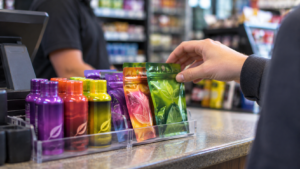
First, many of these products do not accurately report what’s in them. In the San Francisco case, the packaging for the drug reportedly didn’t reveal that it contained anything related to kratom at all, let alone MGM-15.1 There are a number of products that are marketed as “uncaria tomentosa” or “cat’s claw,” which turn out to have potent kratom derivatives, including MGM-15, as a hidden ingredient.
Second, not all retailers fully understand what they are selling. Manufacturers constantly try new formulations and offer new products that have small changes in chemical makeup in an attempt to stay ahead of regulations and enforcement. Whether the retailers’ ignorance is deliberate or well meaning, they may put things on their shelves without really knowing what they are. This doesn’t absolve anyone of responsibility, but it can help explain how it happens.
Third, as we have been reporting here, regulations have been changing rapidly and may change again any day. Since we last wrote about this, MGM-15, MGM-16, and pseudo were moved to temporary Schedule I status, but moving 7OH to Schedule I status was delayed.
Now, authorities are considering changing the temporary scheduling of pseudo to establish specific concentration thresholds. The idea is that after they change the status, they can then reword the regulation to say pseudo “above a certain threshold” will be banned, but substances beneath this threshold will be allowed.5 This is intended to allow sale of kratom while banning several of its derivatives.
Fourth, there is a patchwork of state and federal regulations around kratom and kratom derivatives. It can take time for law enforcement officers to adapt to the various regulations as they are issued and then changed.
Tragically, this allows potentially deadly substances to be put in front of someone standing at a counter who has no clue all this is happening. For those who are already vulnerable to addiction, the idea of an “herbal supplement” that seems legal but gets them high can seem irresistible.
How to Protect Yourself From Hidden Opioids in Gas Station and Smoke Shop Products
To avoid being the next victom in this ongoing story, be suspicious about products being sold as herbal supplements in colorful packaging with extravagant claims. This is doubly true for anything sold at a convenience store, smoke shop, or the like.
If the product doesn’t have a clear list of ingredients, don’t take it. If it has several doses at increasing potency, encouraging you to “work your way up,” don’t take it. If it warns you that it should only be taken by people over 18 or 21, don’t take it.
Avoid anything that says “cat’s claw” or “uncaria tomentosa.” These products have been found to sometimes contain MGM-15, making them dangerous and illegal.
Look out for government notices warning about products with certain packaging or claims.
Signs of an Opioid Overdose and What to Do
Recognize the signs of an opioid overdose. These include very slow or stopped breathing, pinpoint pupils, limp body, an inability to wake the person, gurgling sounds, and blue or gray lips.6
If you think an opioid overdose might be happening, call 911 immediately, and administer naloxone (Narcan) if available. Naloxone may work on kratom derivatives, but it can take more than one dose. Even if the person wakes up and says they are fine, insist on emergency medical evaluation anyway.
If you or someone you love has developed a problem with kratom-derived opioids, effective treatment is available. Seeking professional help can make the process of withdrawal and recovery safer and more manageable.
How Windmill Wellness Ranch Can Help With Kratom Derivative Addiction
At Windmill Wellness Ranch, we have been helping people face kratom, MGM-15 & MGM-16, 7-OH, and pseudo since clients first started to show up having used these drugs. This is more than a headline to us. This is a real problem facing the real people who come to us for help.
At Windmill, we are on the cutting edge of treatment for kratom and its derivatives, helping to create safe protocols for detox and treatment. We continue to work with Johns Hopkins University to advance research in the field.
We understand how difficult it can be. We can help.
We don’t just help people address drug use; we also help them navigate underlying mental health concerns, along with teaching practical techniques to stay sober and live a great life.
We also include families in our treatment, because the more support someone has, the better their chances of recovery.
Every day, we see that when people believe they can recover and feel good about themselves, they are much more likely to find hope and healing. We specialize in compassionate, evidence-based treatment for both addiction and trauma, helping individuals and families rebuild stability and hope. If you or someone you love needs support, we are here. Call 830-935-2800 or contact us online to take the first step toward healing.
References
- Baker, A. (2026). SF reports first death from kratom-derived opioid, MGM-15. Retrieved from: https://www.kron4.com/news/bay-area/sf-reports-first-death-from-kratom-derived-opioid-mgm-15/
- Downing, J. (2026). Kratom products linked to 4 deaths in Utah as officials warn of potentially deadly mislabeled products. Retrieved from: https://www.msn.com/en-us/news/other/kratom-products-linked-to-4-deaths-in-utah-as-officials-warn-of-potentially-deadly-mislabeled-products/ar-AA2dVxJE
- Smith, K. E., Epstein, D. H., & Weiss, S. T. (2024). Controversies in assessment, diagnosis, and treatment of kratom use disorder. Current psychiatry reports, 26(9), 487-496.
- Eccarius, L. K., Walton, S. E., Papsun, D. M., Logan, B. K., & Krotulski, A. J. (2026). Quantification of kratom alkaloids mitragynine, 7-hydroxy mitragynine, mitragynine pseudoindoxyl, and dihydro-7-hydroxy mitragynine in forensic casework and medicolegal death investigations. Journal of Analytical Toxicology, 50(9), bkag090.
- Federal Register. (2026). Schedules of controlled substances: Temporary placement of 7-Hydroxymitragynine and mitragynine pseudoindoxyl above a specified threshold in Schedule I and temporary placement of MGM-15 and MGM-16 in Schedule I; Proposed rules. Federal Register, 91(197), 65370-65381.
- Center for Disease Control. (2026). Signs of opioid misuse, opioid use disorder, and overdose. Retrieved from: Signs of Opioid Misuse, Opioid Use Disorder, and Overdose
Frequently Asked Questions About MGM-15 and Gas Station Kratom Products
1. If MGM-15 is a Schedule I drug, how can stores still sell it?
They can’t legally sell MGM-15. However, making something illegal doesn’t automatically make it go away. Some store owners and staff may not know what their products contain, while others may not care. Packaging can be deceptive and incomplete, making it harder for stores, law enforcement, and consumers to know if they are dealing with illegal substances.
2. Is MGM-15 the same thing as kratom or 7OH?
No. They are relatives but not the same. Natural kratom comes from the leaves of a Southeast Asian tree and has trace amounts of 7OH and pseudo in it, but may be used safely in moderation (the fact that pseudo shows up at all naturally is a recent discovery). Products that contain mostly 7OH can be highly addictive and dangerous. MGM-15 is a chemically modified derivative of 7OH that also produces powerful opioid effects, including the possibility of overdose.
3. Are all kratom products illegal in the United States?
No. Natural kratom is not currently a federally controlled substance, although some states and local governments have banned or restricted it. A number of kratom derivatives, such as concentrated 7OH and MGM-15, are on the federal Schedule I list, meaning they cannot legally be sold or used.
4. Can Narcan reverse an overdose involving MGM-15?
While there isn’t enough clinical evidence to say for sure, since MGM-15 acts as an opioid, if you suspect overdose, call 911 immediately and administer Narcan (naloxone). It may take more than one dose. Even if the person responds to Narcan, don’t assume they are safe. Always have them evaluated by an emergency medical professional.
5. How can I tell whether a gas station or smoke shop product contains a dangerous opioid?
There is no way to know for sure, so always be careful. The safest route is to avoid buying “herbal supplements” from gas stations, smoke shops, or similar settings. Anything that is labeled as “cat’s claw” or “uncaria tomentosa” should be avoided, as such products have been found to contain MGM-15. Anything sold at such shops that promises strong pain relief, euphoria, or opioidlike effects should not be taken. If the ingredients aren’t clear, don’t take it.